
Logo Édition Originale
  • About us
  • Contact
  • Flag en
    • Icone favoris
    • Connexion
    • Icone panier

Literature
LiteratureFirst EditionsSigned Books, Presentation CopiesIllustrated BooksForeign LiteratureNovels, Short Stories and TalesPoetryTheaterMemoirs, Biographies and EssaysErotica
Antique Books (1455-1820)
Antique Books (1455-1820)First EditionsLiteraturePhilosophyArtHistoryScienceReligionTravelIllustrated Books
Fine Arts
Fine ArtsFirst EditionsSigned Books, Presentation CopiesPainting & DrawingSculpturePhotographyCinemaTheaterMusic & DanceArchitecture & UrbanismDesign & FurnitureFashion
History
HistoryFirst EditionsSigned Books, Presentation CopiesPrehistory & AntiquityMiddle AgesRenaissance & Modern TimesFrench Revolution & EmpireFrom the Restoration to the CommuneFin de Siècle & Belle EpoqueWorld War IThe Interwar PeriodWorld War IIContemporary EraThroughout the Ages
Travel & Exploration
Travel & ExplorationFirst EditionsSigned Books, Presentation CopiesEuropeAmericasMiddle East and Arab WorldSub-Saharan AfricaAsiaOceaniaAcross the World
Science, Medicine & Technical Innovations
Science, Medicine & Technical InnovationsFirst EditionsSigned Books, Presentation CopiesMedicinePhysical Sciences & ChemistryNatural SciencesGeography & AstronomyLogic and MathematicsTechniques & Crafts
Social Science
Social ScienceFirst EditionsSigned Books, Presentation CopiesSociology & AnthropologyPhilosophyPsychoanalysis & Psychology Law & JurisprudenceEconomics & PoliticsLinguistics
Religion & Occult
Religion & OccultFirst EditionsSigned Books, Presentation CopiesJudaicaChristianityIslamSpiritualityMythology & PaganismWitchcraft & DemonologyOccult & Spiritism
Social History
Social HistoryFirst EditionsSigned Books, Presentation CopiesAnarchism & UtopiaSocialism & CommunismSyndicalism & Social AdvocacyParis CommuneTotalitarianism
Literary and Artistic Periodicals
Literary and Artistic PeriodicalsLiterary and Art PeriodicalsPre-first EditionsSymbolism & Decadent Dadaism & SurrealismAvant-gardeArt & PoetrySatirical MagazinesAntiquarian Newspaper IssuesIllustrated periodicals
French Regional Literature
French Regional LiteratureNord, Picardy, NormandyAlsace & LorraineParis & Île de FranceBrittany & Loire Centre, Auvergne, LimousinLyonnais, Dauphiné, AlpsBurgundy, Franche-Comté, ChampagneSud-Ouest & LanguedocCharentes & AquitaineProvence, Côte d'Azur, CorsicaAcross France
Lifestyles
LifestylesFirst EditionsSigned Books, Presentation CopiesWine & GastronomyHunting, Fishing & NatureCircus, Magic & IllusionSports & GamesCaricatureNobility & Heraldry & GenealogyBibliography & Book History
Signed Books, Presentation Copies
LiteratureFine ArtsHistoryTravel & ExplorationScience, Medicine & Technical InnovationsSocial ScienceReligion & OccultSocial HistoryLifestyles
Autograph Letters & Manuscripts
Autograph Letters & ManuscriptsLiterary ManuscriptsArtist's ManuscriptsHistorical ManuscriptsScientific manuscriptsSigned photographs
Artworks
Artworks16th-18th Century Prints19th Century Prints & Lithographs 20th Century Prints Vintage PostersPaintings & SculpturesDrawings, Inks & WatercolorsPhotographsDescription of Egypt (1809)Antique Maps
Illustrated Books
Illustrated Books16th-17th Century Illustrated Books 18th Century Illustrated BooksRomantic Illustrated Books (1800-1860)Fin-de-Siècle Illustrated Books (1860-1900)Modern Illustrated BooksModern and Contemporary Illustrated BooksArtist’s Books
Fine Arts
Fine ArtsFirst EditionsSigned Books, Presentation CopiesPainting & DrawingSculpturePhotographyCinemaTheaterMusic & DanceArchitecture & UrbanismDesign & FurnitureFashion
The religions of the BookThe religions of the Book
The religions of the Book

Much like the papal procession that ends at Saint-Michel, named for the archangel shared by the three religions of the Book, we offer you a heavenly Abrahamic selection. It would take the very devil to keep you from finding your numinous bliss here...

Heavyweight Summer Beach ReadsHeavyweight Summer Beach Reads
Heavyweight Summer Beach Reads

Ravenous readers, set aside short tales and order à la carte from our selection of literary heavyweights: epics, sagas, odysseys, sweeping frescoes, monumental novels, cycles, tetralogies…

Masterpieces to be savoured without restraint—right down to the very marrow of their substance!

Short Stories & TalesShort Stories & Tales
Short Stories & Tales

Instead of searching for lost time, try finding it again with a short story: they are often the finest fare, and at the tale end, these brief accounts prove joys beyond compare. So let the simple heart of Bartleby transform the balls of tallow into the Venus of Ille…

The Ancient AuthorsThe Ancient Authors
The Ancient Authors

From Attic classics to apothecary's Latin. come feast at the banquet of the ancients. On the menu at Aesop's tables: Roman let us scroll, Gaelic reads,  Ovid's spoil, Chinese feud.

Foreign LiteratureForeign Literature
Foreign Literature

Pardon my non-french! You are all forgiven, you strange strangers who delight us with your torrents of tongue, your lexicons of legend, your diamonds of idiom. Let us relish the ripeness of your rhetoric, the wild, unheard-of wonders you weave, told in the tongue of Shakespeare, Goethe, Li Po, Dante, Cervantes, Khayyam, Sappho - or in the translations of Gide, Nerval, Judith Gauthier, Rivarol, Oudin, Toussaint, or Renée Vivien!

Browse our Selections
You wish to be assisted by our bookseller to find a gift?
Our team will send you a personalized selection within approximately 24 hours.
I prefer to be contacted by
Explore
Advanced search
  • Home
  • Browse collection
  • Latest acquisitions
Browse
All CollectionsCatalogues
Resources
  • Authors
  • Publishers
  • Bookbinders
Services
Sell to usTailored GuidanceSet an alert
  • Media
  • About Us
  • Where To Find Us
  • Contact
Change Language
Flag en
Logo Édition Originale
Flag en
Connexion
Icone panier
Rare Books
Autographs
Art
Gifts
Sell to usNews

Librairie Le Feu Follet•31 rue Henri Barbusse, 75005 Paris•+33 1 56 08 08 85•Monday - Friday, 11am to 7pm
Edition-Originale.com
Univers
Media / Investigations

November 6, 2026

A Rare Letter from the Great Saint of the Grand Siècle

Letter signed by Saint Vincent de Paul to the Superior of the Priests of the Mission in Marseille


With the exception of martyrs, the Church requires two miracles for a canonisation. No fewer than 56 miraculous healings are thus attributed to Vincent de Paul. Yet the true miracles of the “patron of all charitable works” are less mystical, though doubtless more admirable still.

Born a “wretched swineherd”, he was ordained a priest and became a teacher, before being captured by Barbary corsairs at the age of 24 and enduring two years of slavery in North Africa.


He devoted the rest of his life to improving the lot of slaves, secured the ransom of 1,200 Christian captives, and had himself appointed chaplain of the galleys in order to assist the convicts, improve their conditions of detention and give them care…


It was, quite prosaically, through his network of influential women friends and his relentless diplomacy that this holy man worked his most moving wonders: saving men, body and soul.
 

Img 2582


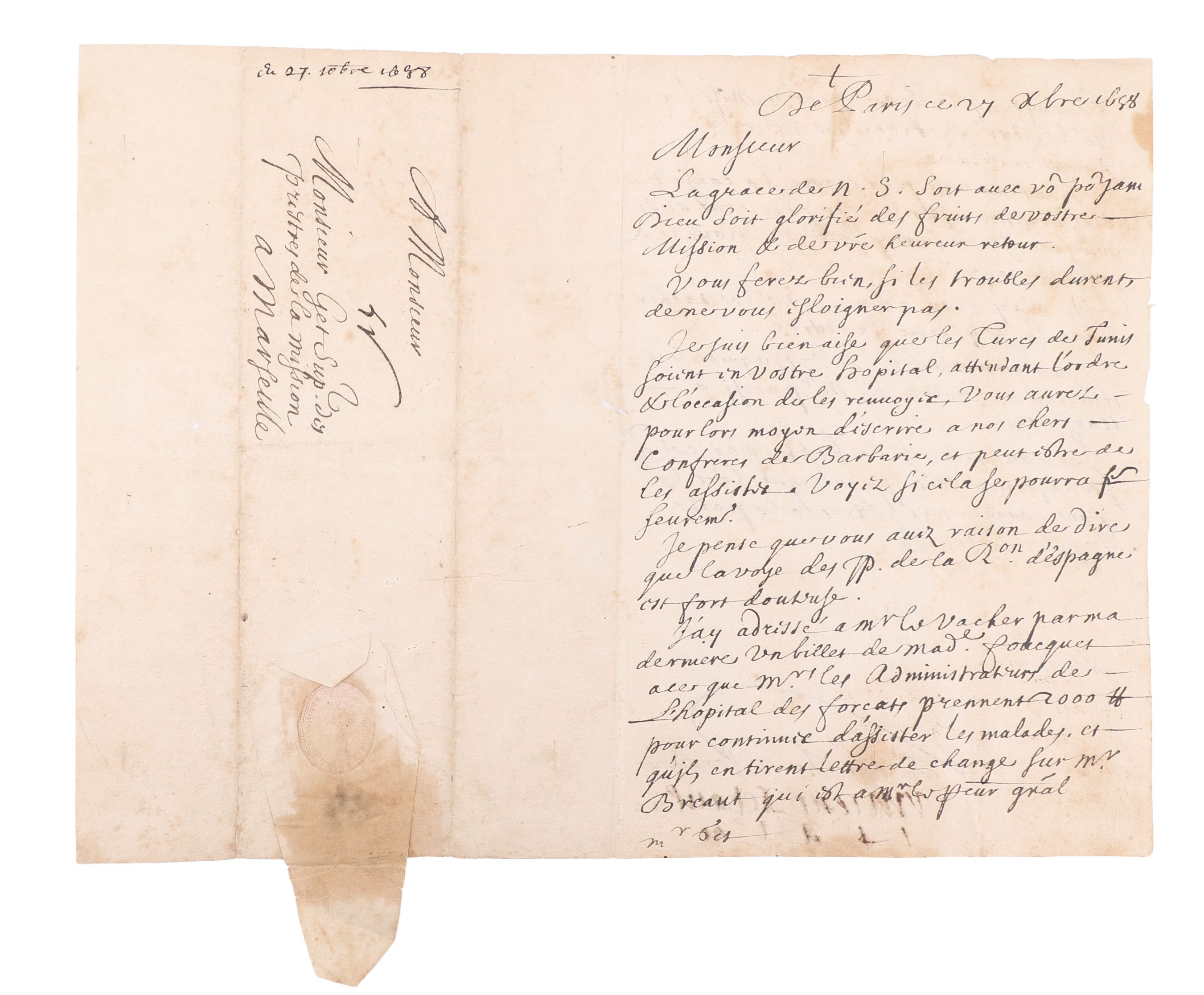
In this exceptionally rare letter, Saint Vincent de Paul fights to save the Christian captives of Tunis, having himself been captured and held as a slave in that very city for two years. 

The letter, recently cited in Vincentian scholarship, is an essential document for understanding the saint's intricate manoeuvres as he arranged to exchange "Turkish" slaves held in Marseille for Christian slaves in North Africa. Through influential figures of the Parisian aristocracy, he obtained funds to support the hospital for galley convicts in Marseille, ran by his correspondent Firmin Get.

“Solid, efficient, with the capacity for hard work that Vincent so prizes, Father Get now dominates the whole of Vincent de Paul's correspondence with his figures and his letters. For it is he who conveys to Barbary, by way of the sailors and merchants who link the two shores of the Mediterranean, the money received from the Mission's bankers in Marseille” (Marie-Joëlle Guillaume).


*

Father Firmin Get, a native of Picardy, entered the Congregation of the Mission on 6 January 1641 and took charge of the Marseille house in 1654. Get was Vincent de Paul's second most important correspondent: according to the great Vincentian scholar Coste, no fewer than one hundred and fifty letters addressed to him are recorded. It makes him, together with Vincent's patron and friend Madame de Marillac, his “most favoured” epistolary interlocutor.


Apart from the merchants and craftsmen who had settled there or who called there for trade, the greater part of the Christian population of Tunis and of the two other Ottoman regencies of the Barbary Coast consisted of slaves. The slave trade flourished at the time: “if Vincent knew it well, it is because he was himself an article of import,” as Paul Lapie observes in the Revue Tunisienne. Vincent de Paul was indeed captured and spent two years in Tunis. Very little is known about it, as Vincent de Paul almost never imparted anything on “the most picturesque, even most romantic episode” of his life (Victor Giraud), so much so that it has even been doubted whether he was ever a captive at all. In that same year, 1658, he tried to retrieve and burn the few letters he had written on the subject. Yet this experience undoubtedly had a profound influence on his work.  The saint never ceased to show constant concern for these missions, faced with violence and constant problems of ransoming Christian slaves.


At the time this letter was written, “the situation in Barbary is a web of suffering,” as Marie-Joëlle Guillaume emphasises. Father Jean Barreau, consul in Algiers, was repeatedly thrown into the bey's jails and subjected to the worst tortures. The authorities expected payments promised in exchange for the release of captives, while Vincent de Paul waited desperately for a French fleet to be dispatched to settle the matter once and for all. 

“Monsieur,
The grace of O[ur] L[ord] be with you forever!
May God be glorified for the results of your mission and for your safe return! If the troubles persist, it will be well for you not to go far away.
I am glad that the Turks from Tunis are in your hospital, awaiting the order and opportunity to be sent back. This will then give you the means of writing to our dear confreres in Barbary and perhaps to give them some help. See if that can be done safely. I think you are right in saying that sending things by the Spanish Mercedarian Fathers is very uncertain." (translation De Paul University Library)

Vincent de Paul's missionaries had begun working for the material and spiritual welfare of Christian slaves in Tunis in 1645, and in Algiers in 1646. The Congregation took charge of both consulates through the generosity of one of its principal benefactors, Marie de Vignerod de Combalet, Duchesse d'Aiguillon, niece of the late Cardinal Richelieu. As Forrestal and Roșu point out: “ Although de Paul and the missionaries that he sent to the region did not articulate the reasons for their congregation’s presence there in these terms, in practice they stepped in to minister to slaves, to prevent their assimilation to North African and Islamic culture, and to repatriate any who were French Catholics.” (Slavery on the Frontier: The Report of a French Missionary on Mid-Seventeenth-Century Tunis).

After numerous fundraising campaigns, collections in Parisian parishes and gifts from the aristocracy, the situation called for drastic measures, here the sending back of Tunisian galley slaves whom he had persuaded the French Crown to give up:  

“This example [the present letter] clearly shows that Vincent de Paul understood the political manoeuvres of the French court. In this he could rely on his long-standing confidante, the Duchesse d'Aiguillon, and on her influence. It is evident that he used a network of influential women to bring pressure to bear on the court; in this instance, besides the Duchesse d'Aiguillon, it was the wife of Admiral Vendôme. Within this network he regularly found support for his religiously motivated projects. Moreover, he clearly had a thorough grasp of the Mediterranean logic of slavery, as well as of the slave trade. He knew what value the Muslim slaves in Marseille represented and how to make use of it.” (Daniel Steinke, Vinzenz von Paul (1581-1660) und die Praxis der Sklaverei im Mittelmeerraum, 2019).

After this exchange of the “Turks of Tunis,” intended to release funds for the North African missions or to secure the freedom of captives, Vincent de Paul turns to the thorny question of the galley convicts. The task had occupied him since 1618, when he discovered with horror their appalling living conditions. Here he obtains from the mother of the Procureur Général Nicolas Fouquet, the means to support his hospital for galley convicts. He also mentions in connection with the transfer the name of the Duc de Richelieu, General of the Galleys, Armand de Vignerot. The letter also names leading figures of the mission: Philippe Le Vacher, brother of the martyr Jean Le Vacher; Antoine Parisy; and Benjamin Huguier, priest of the Mission in Marseille, who visited the galley convicts stationed in Toulon. 


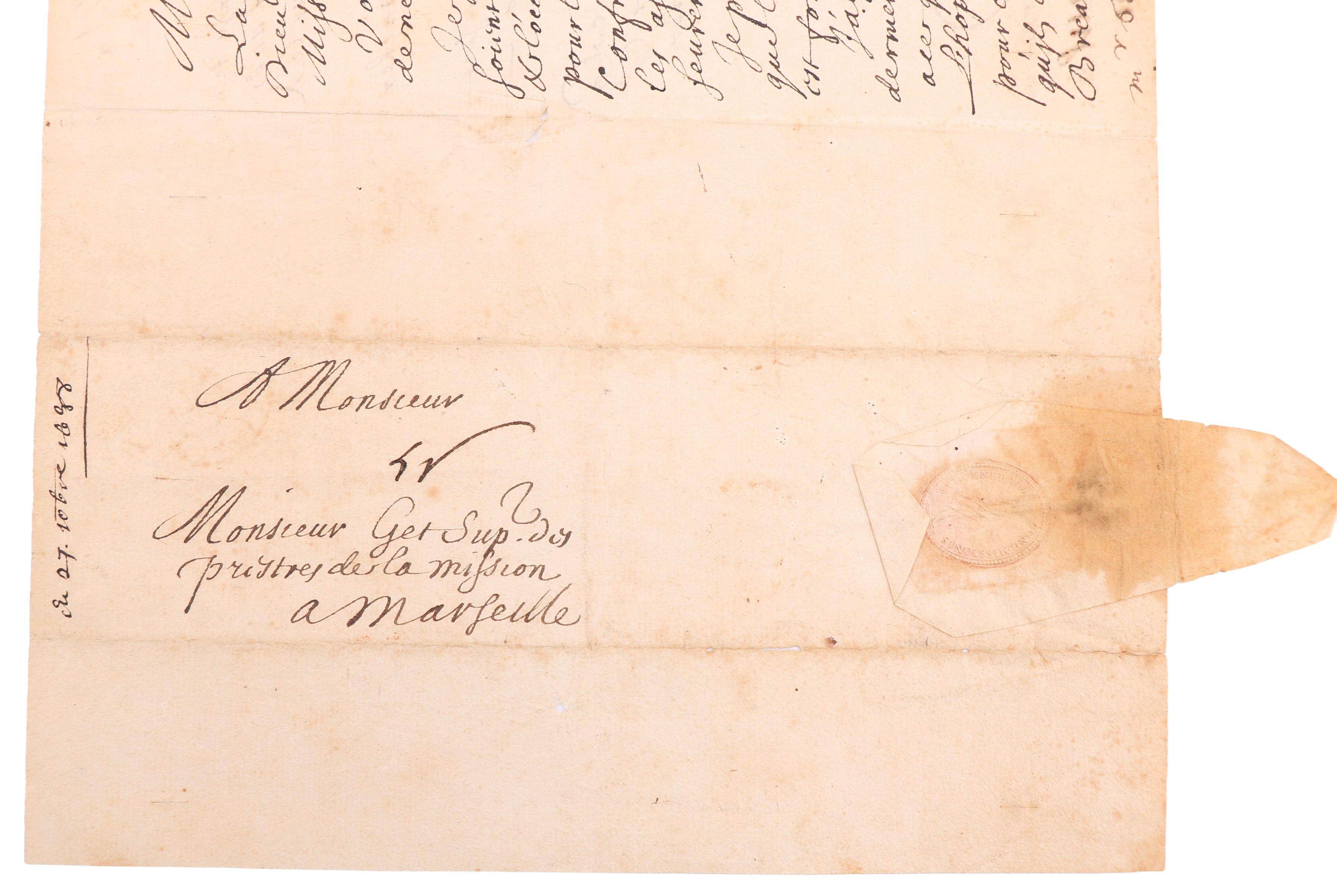
"In my last letter to M. Le Vacher, I included a note from Madame Fouquet stating that the Administrators of the hospital for the captives may take two thousand livres to continue assistance to the patients, and they should draw a bill of exchange on M. Bruand who is with the Attorney General. I will send the letter from the Administrators to the Duc de Richelieu for the new election.
We do not yet have the results of the consultation from the Sorbonne on the case you sent us. I will have someone request them at the first opportunity.
I have nothing to tell M. Le Vacher, except that I received his letter.
I am glad M. Huguier has returned to Toulon and M. Parisy to Marseilles.
I am writing to you in haste because I received your packet just at the time my letters had to be sent to the post.
I am, in O[ur] L[ord],
Monsieur,

Your most humble servant,
Vincent Depaul,
i.s.C.M" (idem). 
 

Img 2587


A precious and moving source showcasing the unremitting efforts of Vincent, who followed in the footsteps of Christ and took on “the condition of a slave”, then, through his labours, restored freedom to more than twelve hundred souls, according to Louis Abelly. 

A fortnight before his death, it was to the very same Firmin Get that he wrote and sent funds to for the galley convicts: “To the very end, he thinks of everything and of everyone; he lets go of none of the reins that Providence has placed in his hands. A good soldier of Christ, he dies, quite literally, in the breach.” (Giraud). His work and his sacrifice would be recognized by the Church very early on: following his beatification by Pope Benedict XIII in 1729, he was canonized by Clement XII in 1737, and finally proclaimed universal patron saint of all works of charity by Pope Leo XIII in 1885.


Provenance: this manuscript formed part of an ensemble of autograph letters addressed to the Marseille congregation, of which Firmin Get was superior, recovered by the superior at the time of the Revolution. Inherited by the Hains family, most of the originals subsequently passed through the hands of the great autograph dealer Charavay in the late nineteenth century.


Bibliography: Lettres de S. Vincent de Paul, Pillet et Dumoulin, 1880, vol. IV, pp. 254-255, no. 1777; Coste (ed.)., Saint Vincent de Paul. Correspondance, Entretiens, Documents, vol. VII, p. 420, no. 2762. Facsimile available at DePaul University Library.


>> See the letter

Investigations
Investigations
Everything you’ve always wanted to know — and also what you think you already know, what you didn’t realize you couldn’t ignore, what you assumed no one knew, along with a few other erudite secrets. The Feu Follet investigations are like your curiosity: sharp and spirited.

Categories
EditorialInvestigationsEventsCataloguesPressCollector's GuidesGlossary of Book TermsAlbumThe EnigmaLe Feu Follet's LetterAll

A question, a comment?
Let's talk

Receive our articles in the Feu Follet's Letter
Subscribe
More articles
November 5, 2026
Ravachol: Anarchist, Murderer and Belle Epoque Icon
"Judge me, messieurs of the jury, but if you have understood me, while judging me judge all the unfortunate who poverty, combined with natural pride, made criminals, and who wealth or ease would have made honest men." (Traduction Mitchell Abidor,"Ravachol’s Forbidden Speech", 2006)
October 16, 2026
Presentation copy from Pagnol to Druon, his admirer
Idealised childhood is an age-old leitmotif, but since the 20th-century it has had a name: Marcel Pagnol. No writer has better captured a child’s sensitivity and capacity for wonder. Among his most fervent admirers is another writer, who would gladly have belonged to his large Provençal family: Maurice Druon. He crowned Pagnol the blessed king of childhood. “How human you are beneath such pleasant appearances! Reading you, I now feel as though I have become one of your childhood friends. And I await the sequel to La Gloire de mon père [My Father’s Glory] as a reward. I admire you and send you a warm embrace. Maurice”
September 4, 2026
Aragon's Earliest Known Poem: The Birth of a Poet Soon to be Buried Beneath the Shells of the Great War
One is not born Aragon, one becomes him. Through the trauma of the first World War, the upheaval of Dadaism and the enthusiasm of Surrealism, through communist conviction, through Resistance to oppression, through love… Before Elsa's gaze, before the Affiches rouges, the comrades, the artistic revolutions (even before the shell that would bury him in the trenches) Aragon is already Aragon, from the very first poem, feverishly written in pencil on a schoolboy's page and given to his friend "Anicet"…
Subscribe to the Le Feu
Follet Newsletter, a singular note
on the ever-changing world of books.
Meticulous and passionate investigations, a selection of new acquisitions, and preview our catalogues in advance.
Services
Expert Guidance
We buy
Valuation
Gift Ideas
Concierge
Create an alert
Orders
Order
Payment
Delivery
Pick Up at Bookshop
Manage your Orders
Return & Refund
Unconditional Guarantee
Certificate of Authenticity
About
Le Feu Follet
History
Our Team
Engagements
Labels
Press
Contact
Resources
Authors
Publishers
Bookbinders
Places of publication
Lexicon
Legal
Terms of Sale
General Terms and Conditions
Privacy Policy & Cookies
Dessin façade librairie Barbusse trait
+33 1 56 08 08 85
[email protected]
Contact us
Logo
Logo
Logo
Dessin façade librairie Barbusse trait
Librairie Le Feu Follet
31 rue Henri Barbusse
75005 Paris (FRANCE)
Monday - Friday from 11 am to 7 pm
Dessin façade librairie Barbusse trait
Galerie Le 121
121 bd Saint-Michel
75005 Paris (FRANCE)
By appointment during exhibitions & events
Langue
Français version
Flag en
SIRET 412 079 873 · © Librairie Le Feu Follet – Edition-Originale.com · All rights reserved