



March 6, 2026
An exceptionally rare work of the Catholic Counter-Reformation by a "simple peasant woman"
An exceptionally rare work of the Catholic Counter-Reformation by Didière Gillet, self-described as "une simple femme de village," [a simple peasant woman] virtually unknown to modern scholarship.
It appears to exist very little commentary on Gillet. The rare references we have found draw exclusively upon this work, the only one bearing her name. It opens with dedications to two celebrated female figures of the Catholic League: an epistle to the powerful Catherine de Clèves, followed by a poem addressed to Anne d'Este. Both had published "Regrets" and "Lamentations" following the death of Henri de Lorraine known as "le Balafré" [the scarred] respectively the husband and son of the two authors, as well as of the Cardinal de Guise, another son of Anne d'Este, both assassinated by the orders of Henri III.
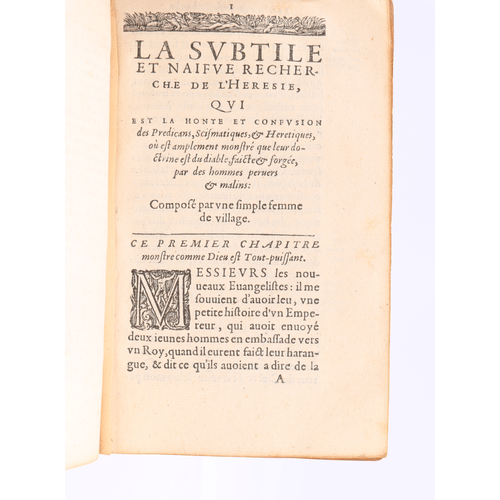
This quite violent text against Protestantism belongs to the broader context of the French wars of Religion. The female voice became an instrument of persuasion under the guise of innocence and ignorance: "Here the published woman is not an example of a literary vocation but of a religious mission fully embraced. The very "simplicity" of the writing, ostentatiously devoid of literary pretension, serves as a means of edification. This is clearly illustrated by the Discours of Didière Gillet, published in 1605; the "Subtile et naifve recherche de l'heresie" is all the more effective in confounding the "prédicants et schismatiques" for being conducted by a "simple femelette" (Evelyne Berriot-Salvadore, "La problématique histoire des textes féminins", Atlantis, Vol. 19, No. 1). A number of women are indeed known to have intervened in these religious controversies: on the Catholic side, the abbess of Chambéry Jeanne de Jussie, and on the Protestant side, Catherine de Bourbon, as well as Marie Dentière (or d'Ennetières), with her "Epistre tresutile faicte et composée par une femme chrestienne de Tornay" (1539). As one of the rare commoners and laywomen authors (Dentière was a former nun) Gillet goes even further than the "femme chrestienne" and identifies herself as "simple femme de village" in the title, then "femme grossière & ignorante" later in the text.
Could this be a mere fiction crafted by men? Stuart Clark, who cites the work for its numerous comparisons between the Reformation and witchcraft, suspects a Jesuit as the true author ("Thinking with Demons: The Idea of Witchcraft in Early Modern Europe"). Yet the royal privilege was granted directly in Didière Gillet's own name, placing her among the very few women writers to have received such a privilege personally rather than through a bookseller or printer: between 1505 and 1604, "only five women were granted a privilege during that time: Marguerite de Navarre in 1547, Louise Labé in 1555, Georgette de Montenay in 1566, Anne de Marquets in 1567, Didière Gillet in 1604" as Michèle Clément and Michel Jourde pointed out in their study on Louise Labé.
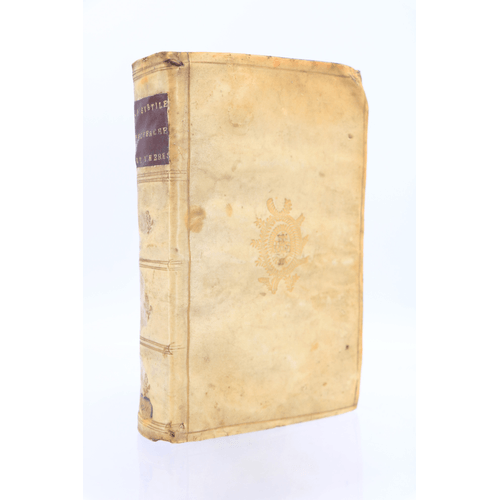
A superb copy in a strictly contemporary gilt vellum binding, of this "curious book [which] warrants a more thorough research" (Eliane Viennot, "Femmes et pouvoirs sous l'Ancien Régime").
Provenance: engraved bookplate of Victor Duchâtaux, bibliophile of the second half of the 19th-century; below it, a manuscript ex-libris of his son-in-law, the engineer Georges Henri Renard.
USTC 6025948.


