



January 9, 2026
A Book to Relieve your Conscience
An interesting book that bears the memory of its previous owner, whose sins can be known by the lifted tabs (and even some missing ones, perhaps evidence of unspeakable transgressions!)
This innovative confessional manual "encouraged self-reflection on several hundred sins, ranging from embracing heresy to cheating at games [to the practice of black magic!]. Categorized according to the Ten Commandments, brief definitions of the sins were printed on pre-cut paper. This allowed the user to pull the slips up individually so that they extended over the superimposed paper margin, thereby serving as topical reminders for reflection and confession, to be tucked under the margin again after the confession. The ability to select, manipulate, and categorize particular textual units introduced in this book can be seen as a precursor to modern information management systems. (Bridwell Library, Southern Methodist University)
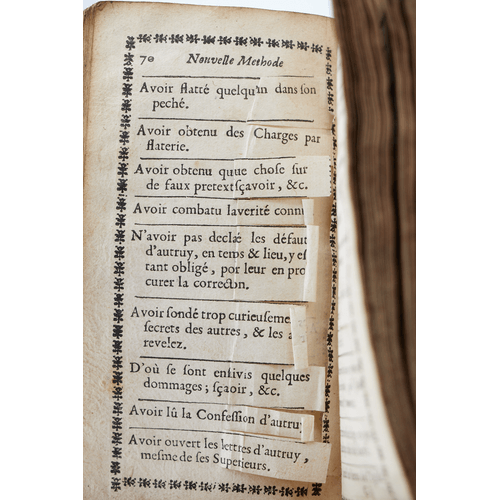
"It is not always easy to engage in self-examination, and it is sometimes even more difficult to confess one's sins, even to one's confessor. Thus the Belgian Franciscan father Christoph Leutbrewer decided to help sinners in their endeavor by publishing an ingenious devotional "mechanical" book: La Confession coupée [The Cut-Out Confession]. Thanks to this small volume, embarrassing confessions no longer had to pass the lips of overly timid sinners. [...] Described in a single pithy line, the various sins were printed, about ten per page, on pre-cut horizontal paper tabs, whose free end was normally tucked into the frame formed by the right margin. When the user wished to take stock of his faults in preparation for confession, he would browse through the volume thematically (certain character flaws being more habitual to him than others) and highlight his sins by lifting the appropriate tabs with the point of a knife or pin.
This long litany of sins (nearly 900 enumerated across 84 pages!) brought together the most heinous crimes with the most venial faults. Thus, the mortal sin of murder presented aggravating circumstances that were the subject of additional tabs, such as "What's more, [having committed] a parricide." Family relationships were the subject of a lengthy section in the same spirit: the act of "Having troubled one's family too much through anger & shouting" included a higher level, "And this habitually." On the other hand, chastising one's wife from time to time was hardly reproached: the only sin here was "Having corrected her too excessively." Certain professions prone to deviance were the subject of particular lists (primarily churchmen, doctors and apothecaries, judges and lawyers, or royal officials). As for "lasciviousness," it was naturally enumerated in detail, from bawdy songs to "dishonest nudities" and other "filthiness."
[...]
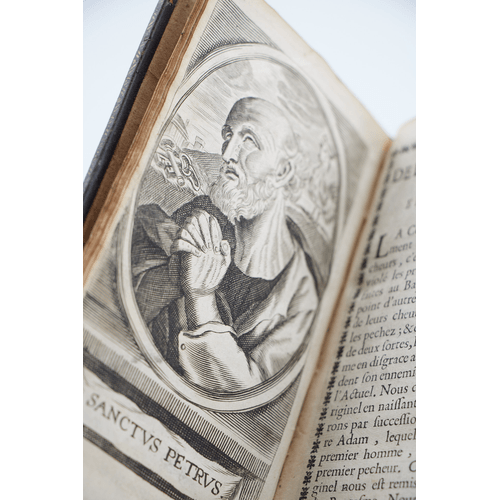
Resolutely didactic, the book opened with some advice for preparing one's soul for the sacrament of confession, but also with a genuine user's manual. Once the tabs were lifted, the small-format volume could be discreetly carried to the confessional, tucked in a pocket, and presented to the priest to inventory the offenses committed without a single word being spoken. Once divine absolution was obtained, cleansing the faithful of all their sins, the paper strips should be reinserted into their slots, thus erasing the tally of faults both physically and spiritually. In the greatest discretion, 'everything is restored & blends in with the other sins, as it was before, so that other persons cannot know the sins of which one has accused oneself.' The book met with immediate success and went through numerous reprintings until the end of the eighteenth century.' (Nicolas Ducimetière, Fondation Bodmer)."


