



July 3, 2026
Investigation on Actes et Paroles
"We called him Papapa. Legend has it - he surrounded us with legends! - that one morning at Hauteville House, while he was working in that glass cage perched at the top of the house, little Georges came in and said: - Hello Papapa! [...] To hear the son of his son Charles who had just died, pronounce this unknown word, the grandfather was overjoyed for he knew the secret language of children: Georges' stammer made him twice a father, much more than a grandfather. [...] ‘My name is Papapa now,' he said, softly. And until he died, my sister and I called him by this dearest name, which he always cherished" (Georges-Victor Hugo, [My Grandfather] Mon grand-père, Paris: Calmann-Lévy)
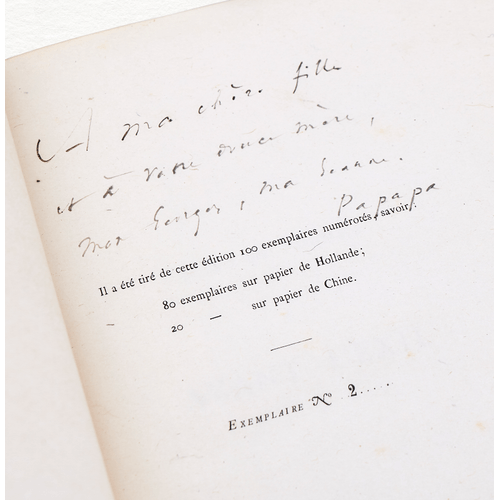
In 1871, after the tragic and unexpected death of his son Charles, Victor Hugo became guardian of his two grandchildren Georges and Jeanne. From then on, he played a large part in their upbringing and spent some of the happiest moments of his life with them, reflected in the countless endearing notes about the two children in Choses vues [Things Seen]. Upon the death of his last son François-Victor, he moved in with Georges and Jeanne's mother Alice at 21 rue de Clichy; on the floor below, he lodged Juliette Drouet. This gave him plenty of time to spend with his "little ones", for whom he organized children's dinners and made plenty of toys. The children are the subject of his immensely popular poetry collection, L'Art d'être grand-père (1877) [The Art of Being a Grandfather]. "Its popularity was immediate and its success resounding, so dazzling was his way of celebrating childhood by telling the story of Georges, Jeanne and himself. By putting children's words into verse so naturally and freshly, Georges et Jeanne's "Papapa" has succeeded like no other in exalting "grandparental" feelings. At home, these feelings are not limited to allowing children to leave their toys lying around on manuscripts: when Alice remarried journalist and politician Édouard ‘Lockroy' Simon – contributor to Le Rappel – Hugo opposed him sharing guardianship" (Sandrine Fillipetti, Victor Hugo)
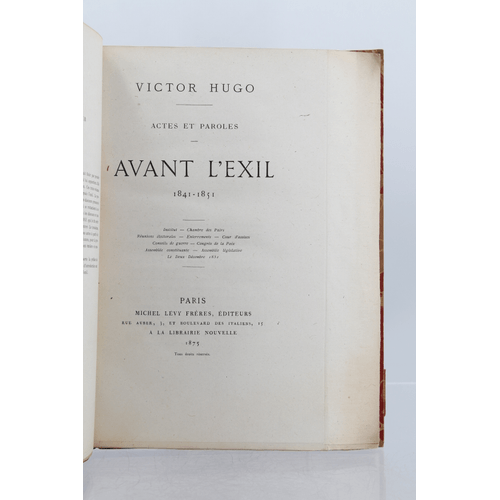
This inaugural volume of Actes et paroles [Deeds and Words] containing Victor Hugo's first major political texts, is a poignant testimony to his humanist commitments. The "little" owners of this precious copy received their grandfather's intellectual and militant legacy: from his "Discours de réception" at the Académie française (1841) to his famous stance against Napoleon III "Révision de la Constitution" ("No! after Napoleon the Great, I don't want Napoleon 'le Petit'!") which led to his exile. At the heart of this compilation is a highly significant text "For Charles Hugo. The death penalty" delivered by Hugo before the Seine Assize Court in 1851 in defense of his son, father of Jeanne and Georges, convicted for an article against death penalty: "What my son has written, he has written, I repeat, because I inspired it in him from childhood, because at the same time as he is my son by blood, he is my son in spirit, because he wants to continue his father's legacy"
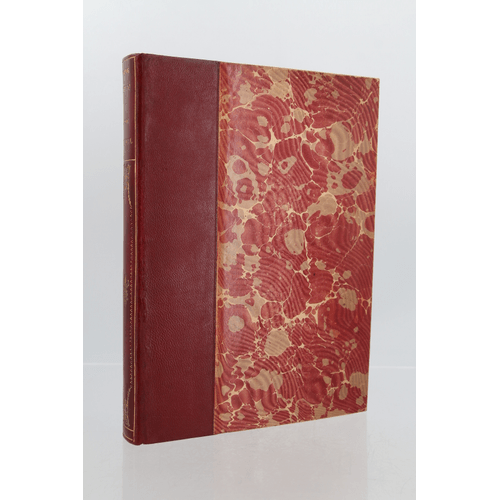
This beautiful gift to two children aged six and seven was undoubtedly offered with the intent to uphold the family tradition of commitment to freedom.


