



June 19, 2026
Presentation copy inscribed by Romain Gary to Alexandre Reza
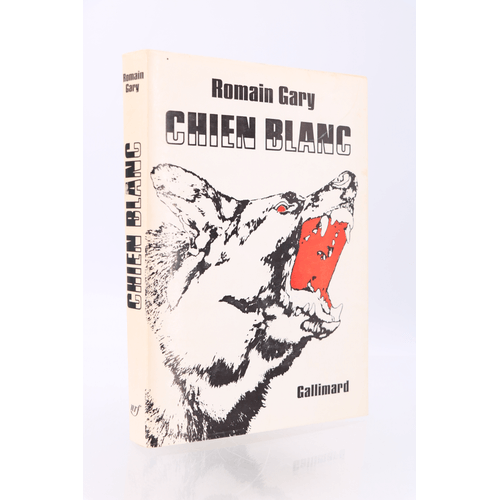
Important presentation copy inscribed by Romain Gary to the jeweller Alexandre Reza.
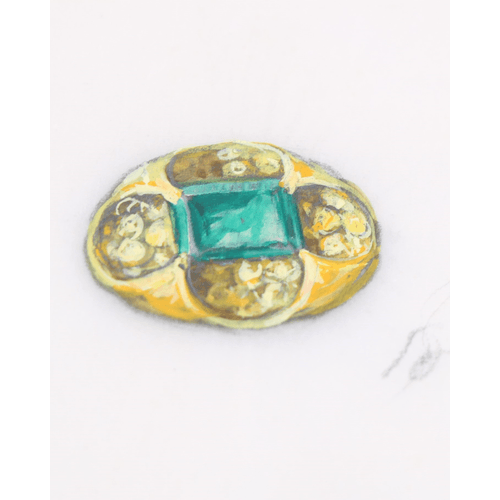
Loosely inserted in a folded sheet of tracing paper is an original colour drawing by the jeweller Alexandre Reza depicting a ring and captioned 'Jonquille" No. 33'
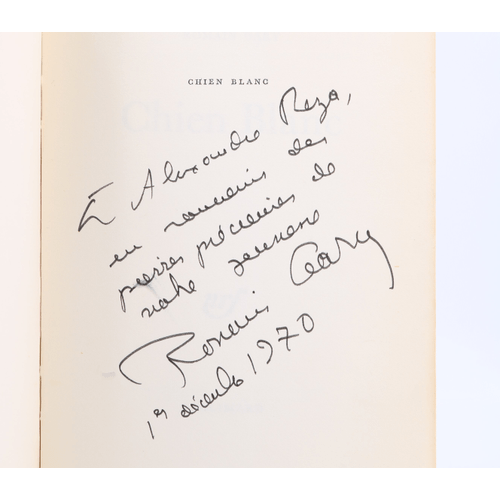
At the height of his fame, Gary addressed this inscription to one of Place Vendôme’s most celebrated jewellers, whose creations continue to fetch remarkable prices at auction:
"To Alexandre Reza, in memory of the precious stones of our youth. Romain Gary, 1 December 1970."
Gary and Reza shared strikingly similar origins: Jewish children born within the Russian Empire, displaced and uprooted before establishing their first true roots in that “dear city of Nice, almost a native city” (Romain Gary, ed. Mireille Sacotte, Légendes du je, 2009, p. 704). Born in 1922, Reza attended the same schools in Nice that Gary had attended a few years earlier.
Whether the future writer’s mother, Mina Kacew, who sold jewellery in order to support her son, ever frequented the shop on rue de France run by Reza’s father, himself a jeweller, remains unknown.
This inscription is the only trace of their childhood friendship – Gary was never particularly forthcoming about the details of his youth. As Dominique Bona observes, he “wrapped in a poetic mist an adolescence that was in fact austere and devoted to study”: “He never spoke of his schooldays, his academic distinctions, or his prizes in French literature. He never mentioned the names of his former classmates. In his picturesque narratives, he always maintained a certain distance from the events he experienced, and quite deliberately preserved a degree of vagueness about his past.
One must therefore turn to the witnesses of his adolescence (classmates such as Pierre Darmon, François Bondy, Sacha Kardo-Sessodf, close friends Sylvia and René Agid, neighbours, shopkeepers from the Buffa district, or the proprietors of establishments such as the Café Washington) in order to reconstruct the scattered puzzle of his memories.”
Yet some remained silent, among them the great Reza, the “jeweller to the international elite”, that same elite of which Romain Gary would later become a celebrated member as one of France’s most famous writers. Jewellery remained omnipresent throughout Gary’s work: poverty concealed beneath splendour, the life-sustaining lie, dignity preserved at any cost. Jewels were both an instrument of survival and a symbol of the social performance enacted by Mina for her son, from which he would later draw inspiration for his novel Lady L.
The paths of Reza and Gary also crossed during the war. Both joined the Resistance: Gary’s countless exploits and decorations are well known; Reza, for his part, was awarded the rank of Commander of the Légion d’honneur, the Croix des Anciens Combattants et Victimes de Guerre, and the Médaille du Combattant Volontaire de la Résistance. It would appear that they maintained ties over many years, a friendship ultimately revealed through Gary’s words in this remarkable inscription.
A significant contribution to Gary’s biography through the inscription in this copy, bringing together two Jewish, Russian-born exiles of Nice, raised among precious stones and ultimately reaching the summit of their respective arts.


